Our story began in 2020, right in the middle of lockdown, in a small workspace in Edmonton. What started as a one-man idea quickly became a community-driven venture. With shops closed and people searching for unique gifts, many of our earliest customers were single mothers looking for something special for their children. Their trust helped us grow at a time when the world stood still.
Word of mouth became our lifeline. Friends told friends, neighbours spread the word, and soon the local car community discovered what we could do. From custom-dipped parts to personalised finishes, their enthusiasm kept the workshop alive and buzzing during those uncertain early days.
By 2023, demand had outgrown our small beginnings. We expanded into larger premises in Chester, opening the door for even more creativity and capacity. The support of the car community remained strong, and new customers came from every direction—sneaker collectors wanting fresh custom trainers, homeowners seeking unique décor pieces, and people of all ages looking to turn ordinary items into something personal.
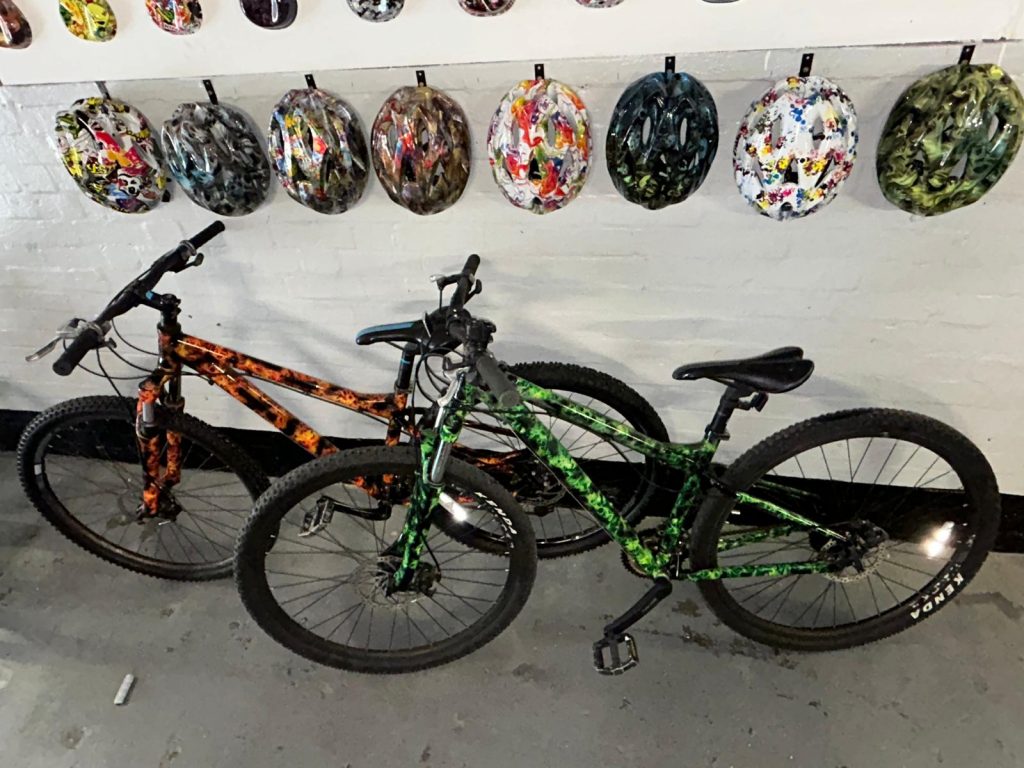
Now in 2025, the landscape has shifted once again. With bike thefts and hijackings on the rise across the UK, our work has taken on new meaning. People want their bikes to stand out, to be recognisable, to be unmistakably theirs. Our custom hydro-dipped designs have become part of that solution, helping riders reclaim a sense of identity and security.
From a humble lockdown project to a growing creative hub, our mission has stayed the same: transform the everyday into something that feels truly yours. And as we continue to grow, one thing remains unchanged—our community is at the heart of everything we do.
About Hydro Dipping
Hydrographic dipping (also known as water transfer printing, hydro dipping, hydro imaging, or camo dipping) is the process of applying a decorative finish to 3D products. Any non-porous surface that can be submerged in water can be decorated. If you can get paint to adhere to the part, you can most likely decorate it with this process. Examples of such materials are alloys, plastics, glass, hardwoods, fibreglass, ceramics, and metals. Products are decorated with a high-quality pre-printed image on a thin base of soluble film.
This printed film is then placed on the surface of the water and sprayed with an activator, causing the base to dissolve. The film is activated, causing the image/ink to remain floating on top of the water. Next, the prepared part is immersed in the water, and the upward pressure of the water causes the ink to wrap around and adhere to the item. After the item has been submerged, it is removed from the water, cleaned and then coated with a high-quality powder coat or automotive wet spray clear coat.